Recognizing Impulsivity in Your Child’s Day
Recognizing Impulsivity in Your Child's Day
It Is More Than Just Not Waiting Their Turn
Have you ever looked at your child after they did something completely unexpected and thought, "Why would you do that?"
The question hangs there, full of confusion and frustration and maybe a little worry. These moments, where the action arrives before the thought, leave parents exhausted and out of ideas.
I have been there.
I have ADHD, and I did not know that for years, including years when I was already a practicing pediatrician. I spent a lot of that time hearing impulsivity described to me in appointments and responding the way I had been trained to. Reinforce the rule. Add structure. Encourage consistency at home. Reasonable advice. It rarely moved anything.
What I eventually understood is that what looked like a lack of thought was a brain working faster than its own brakes. That shifted my entire approach, from frustration to something more useful.
These actions are usually not defiance. They are impulsivity, a core feature of ADHD. Recognizing that is the first step away from a cycle of punishment and toward support that actually works.
What follows is what impulsivity looks like across an ordinary day, from the breakfast table to the playground.
What Impulsivity Looks Like at Home
Home is often where impulsivity is most visible, because it is the safest and least structured place your child spends time.
Every child grabs a cookie without asking now and then. For a child with ADHD, these moments are frequent enough to shape the mood of the house.
Interrupting conversations. They cut into whatever is happening, unable to wait for a pause. To them it feels urgent, not rude.
Grabbing without asking. A sibling's toy, a snack from the pantry. The immediate want arrives and the social rule does not arrive in time to compete with it.
Difficulty waiting their turn. Waiting for a turn in a board game can feel physically uncomfortable. That discomfort often shows up as frustration, quitting, or trying to take over.
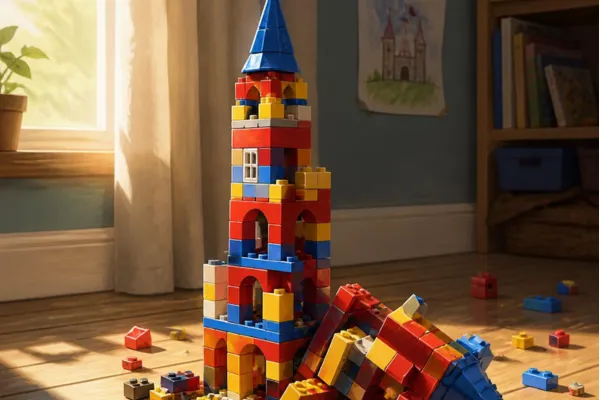
Emotional outbursts. A tower falls, or the answer is no, and the reaction is immediate and large. The feeling arrives faster than any capacity to regulate it. I wrote more about what is happening during those moments here. [link to outbursts post]
Physical impulsivity. Jumping on furniture, running through the house at the wrong moment. A sudden burst of energy with nothing in place to contain it.
What It Looks Like at School
A classroom asks for sitting still, listening, and waiting, which means it produces a nearly constant stream of moments where impulsivity surfaces.
Blurting out answers. Not to disrupt. The excitement of knowing the answer simply outruns the rule about raising a hand.
Getting out of their seat. Wandering, sharpening a pencil for the fourth time, visiting a friend's desk. The impulse to move is stronger than the instruction to stay.
Starting before instructions finish. They begin the assignment while the teacher is still explaining it, which usually means redoing it. This is impulsivity and working memory arriving at the same problem from two directions. [link to working memory post]
Struggles with personal space. Standing too close in line, touching someone's things. The internal pause that would flag a boundary is not there yet.
What It Looks Like With Friends
Friendship runs on a constant balance of talking and listening, sharing and waiting. That balance is genuinely hard for an impulsive child, even one with entirely good intentions.
Saying the unfiltered thing. "Your drawing is messy." They did not mean to wound. The thought traveled from brain to mouth without stopping anywhere.
Difficulty sharing. During play, the immediate want wins over the agreed rule.
Play that gets too physical. Excitement spills into a hug that is too tight or a game of tag that is too rough. Moderating physical response in a moment of high feeling is its own skill.
The Why Behind the Action
After enough of these days, it is easy to land on "my child is not listening" or "my child does not care about the rules."
Impulsivity is neither. It is a neurological difference in the brain's executive function system.
Here is the visual I show parents. Make a fist with your thumb tucked inside and hold it up where you can see it.
The knuckles are the smarts part, and in these kids it is often working beautifully. The fingertips are the front of the brain: pausing, planning, weighing consequences, regulating emotion. That front part develops later and less evenly in ADHD, which means the pause between impulse and action can be very short or missing entirely.
(The hand model of the brain comes from Dr. Dan Siegel.)
So when your child blurts out an answer, the rule did not lose to defiance. The rule never got a chance to arrive.
This is also why "I don't know why I did it" is usually an honest answer rather than an evasion.
Your child is being asked to explain a decision that did not happen. There was no moment in which they weighed it, no deliberation to describe. When we hear that answer as stonewalling, we press harder for a reason that does not exist, and the conversation goes somewhere neither of you wanted.
Understanding this changes the question. Not "why is my child misbehaving," but "what skill is still under construction, and what can hold the gap in the meantime."
Where to Start
Once you recognize impulsivity for what it is, the work shifts from managing behavior to building the pause. The goal is not to control your child. It is to help them develop their own controls over time, with support in place while that happens.
Create structure and predictability. An impulsive brain does better when it knows what comes next. Visual schedules, timers, and consistent routines reduce the number of moments where something unexpected has to be navigated on the spot. External structure holds what internal regulation cannot hold yet.
Practice the pause when nothing is at stake. Do not wait for the hard moment to teach the skill, because the hard moment is when it is least available. Before leaving the house: "Let's pause. What three things do we need?" Before a game: "Let's pause and go over the rules." Small, low-pressure reps build the habit somewhere it can actually be built.
Use a cue instead of a lecture. In the moment, a long explanation lands on a brain that is not receiving explanations. A quiet hand signal that means wait your turn. A word you agreed on together that means take a breath. The cue works as an external brake while the internal one is still coming online.
Agree on the cue together, in a calm moment. A signal your child helped choose is one they will actually respond to.
Frequently Asked Questions
How do you calm impulsivity in the moment?
Mostly you prevent it upstream rather than calming it in the moment. Predictable routines, enough sleep, enough movement. When your child is already in an impulsive state, keep it short and calm, use the cue rather than the lecture, and redirect the energy somewhere it can go. The teaching happens later, when the thinking brain is back.
What triggers impulsivity?
Strong emotion of any kind, including excitement. Also unstructured time, overstimulation, hunger, and fatigue, all of which lower the capacity to self-regulate. Boredom does it too, which surprises parents, since it looks like the opposite of overwhelm and produces the same result.
Is impulsivity the same as hyperactivity?
No, though they often travel together. Hyperactivity is about movement and restlessness. Impulsivity is about the missing pause between impulse and action. A child can be impulsive without being physically hyperactive, which is part of why it gets missed in quieter kids.
How can a teacher support an impulsive child in the classroom?
Seating away from high-traffic areas. Non-verbal cues instead of public correction. Short movement breaks built into the day rather than offered as a reward. A fidget tool, if it helps rather than distracts. And a designated spot to reset that is understood as a support, not a consequence.
Finding Peace in the Process
Recognizing impulsivity as neurology rather than a behavioral choice is the most useful shift you can make.
It lets you meet your child where they actually are. It replaces frustration with something closer to curiosity, and reaction with intention.
Every time you help your child practice a pause, or offer a cue instead of a correction, you are helping build the thing that is missing. Not enforcing a rule they already know.
This is not a quick fix and I am not going to pretend otherwise. It is slower than a consequence and it works better over years. With patience and the right scaffolding, that gap between impulse and action gets wider, and your child gets to be the one deciding what goes in it.
Skills grow with support, not shame. And you do not have to do this alone.
Warmly,
Dr. Grizelda Anguiano Anchored Pediatric Mental Health Anchored Coaching
Educational information, not medical advice. This content does not diagnose any individual child and is not a substitute for evaluation by your child's physician. Impulsivity also occurs with anxiety, sleep problems, and other conditions, and within developmentally typical ranges depending on age. If it is new, worsening, or interfering with school and friendships, that is worth an evaluation. Coaching is educational skill instruction, not therapy, medical treatment, psychological testing, or a diagnostic evaluation, and it works alongside an IEP or 504 plan rather than in place of one.